Choose your language:

FLOWER GARDEN
Garden Flowers, Garden Plants and Types of Flowerswww.Flowers-Gardens.net |
|
Search | ANTIRRHINUM FlowerANTIRRHINUM
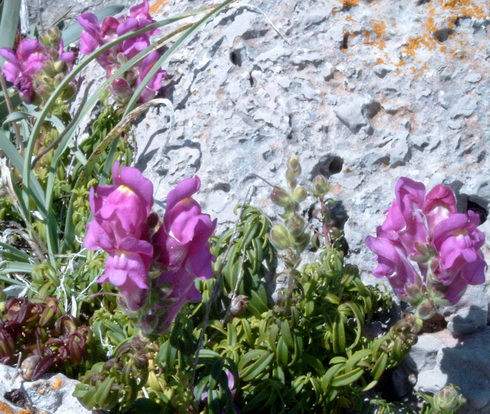
Snapdragon or antirrhinum is a time old English plant. It was originally a wall plant. Modem cultivation has raised its height from six or nine inches to two feet or so, diversified and multiplied its colorings and increased the size of the individual flowers. While, strictly speaking, a perennial, the snapdragon is often at its best if treated as an annual or biennial: the plants can be raised from seed, sown in August where they are to flower, under the protection of a south Avail, and thinned out in the following spring; sown in open seed-beds in exposed positions in June, and planted out during the early months of the next year; or sown in a heated greenhouse in February, the seedlings being planted and out of doors in May. The snapdragon can also be propagated by cuttings. Among the tall sorts, growing from 3 to 4 feet in height according to the nature of the soil in which they are planted, the following are noteworthy: White King (pure white), Yellow King (strong growing deep yellow), Crimson King (deep velvety crimson), Cottage Maid (pink and white), Moonlight (apricot yellow flushed with red). Vermilion Brilliant (orange scarlet), Pink Beauty (rose pink), Venus (delicate pink), Nigrescens (dark crimson). The following are twelve fine intermediate varieties (18 to 24 in. high): White Beauty (pure white), Yellow Queen (largo yellow flowers), Amber Queen (canary yellow, flushed pink), Bonfire (orange butf), Carmine Queen (rose carmine), Coccinea (orange scarlet), Cottage Maid (pink and white). Fascination (pink), Fiery Belt (orange red with white tube), Nelrose (deep rose pink), Nobile (white and crimson) The Fawn (terra-cotta and pink). Most seedsmen have their own named varieties. The torn thumbs (about 12 in. high) are generally grown under colors. Most of these choice varieties must be treated as annuals or biennials except in t h e favored districts of t h e south and west of England, where they often establish themselves permanently. Bedding antirrhinums are largely planted instead of t h e torn thumb varieties: they grow from 10 or 12 inches high and make a brilliant show, as most of the flowering shoots are of uniform height. If sown in summer and planted in well-drained soil in sheltered places in September antirrhinums will stand most winters and flower a month earlier the following year t h a n spring sown plants. They are then biennials. When treated as annuals they are generally sown in February in boxes in a greenhouse where there is a gentle heat, or in a heated frame; germination is then rapid. The most difficult stage in culture is before the seedlings obtain their second leaves. Then they are liable to damp off or to be scorched out of existence by strong sunshine unless carefully looked after. When the plants are big enough to handle easily they must be transplanted 2 to 21 in. apart, i n to other boxes or frames where they will grow till planting-out time, being gradually hardened in view of this. Planting or transplanting in the open beds or borders should take place in April or early May. If in lines, the intermediates ought to do well at 12 in. apart, the tails at 15 in., while the torn thumbs require 9 in. After the first two have grown to a height of 6 or 8 in. each plant must be staked, 12-in. stakes for intermediates and 18-in. stakes for talls. Share in: |
 |
