Choose your language:

FLOWER GARDEN
Garden Flowers, Garden Plants and Types of Flowerswww.Flowers-Gardens.net |
|
Search | Cattleya FlowerCattleya
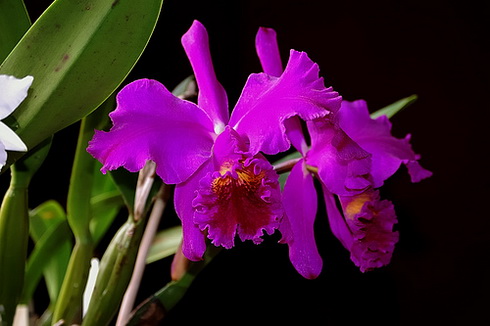
Type: Perennial Flower Species: 42 Height: 5 - 15 Growing: Central America Flowers: Pink, Violet, Blue Kingdom: Plantae Unranked: Angiosperms, Monocots Order: Asparagales Family: ORchedaceae Genus: Cattleya CATTLEYA. One of the chief groups of hot-house orchids consisting of some fifty species and innumerable hybrids; many have large and particularly handsome flowers. The labiata group of about 20 species has a single broad ascending leaf, and the flowers are large, usually lilac or rose-purple with a richly coloured lip and some yellow in the throat. This group includes Cattleya labiata, the original species introduced about a century ago; Mossiae and Mendelii, blooming in spring; Dowiana, Gaskelliana and Warscewiczii, flowering in summer and early autumn; Percivaliana, Schroederae and Trianae, which flower in winter. New hybrids, raised in large numbers by orchid growers, are now chiefly cultivated. In the slender bulbed or diphyllous group, the flowers are smaller and have a three-lobed lip, the stems bearing a pair of spreading leaves at the summit. A third group also has the two-leaved stem, but has an entire lip. The hybrids far outnumber the species, those of the labiata group being the finest. Cattleyas are easily grown in a suitable house, and a succession of bloom can be maintained practically throughout the year. Artificial heat is generally required, except perhaps in the height of summer. The following temperatures (F.) should be aimed at: Winter: 55′ to 00° at, nigh ; 00° by day; 65° to 70° with sun. Spring: and autumn: 60° to 05° at night; 05° to 70° by day; 70° to 75° with sun. Summer : 05° to 08° at night; 70° to 75° by day; 75° to 80° with sun. These plants do best in pots in a fibrous compost, which must be sufficiently open to allow of the free passage of surplus water, abundance of water being required during active growth. The compost may consist of decayed leaf-mould and fibre in equal proportions with a little chopped sphagnum moss. The pots should be about half-filled with clean crocks. The proper time for potting or adding new compost is when the plants begin to produce new roots. Cattleyas differ in their time of flowering, especially in the C. labiata group, some of which bloom immediately the young growths are completed, others after a short rest in the autumn, while the remainder wait until the following spring; a little more water should be given as soon as the buds begin to push in the sheaths. See Orchid Pron. Cat’-le-a. Share in: |
 |
